
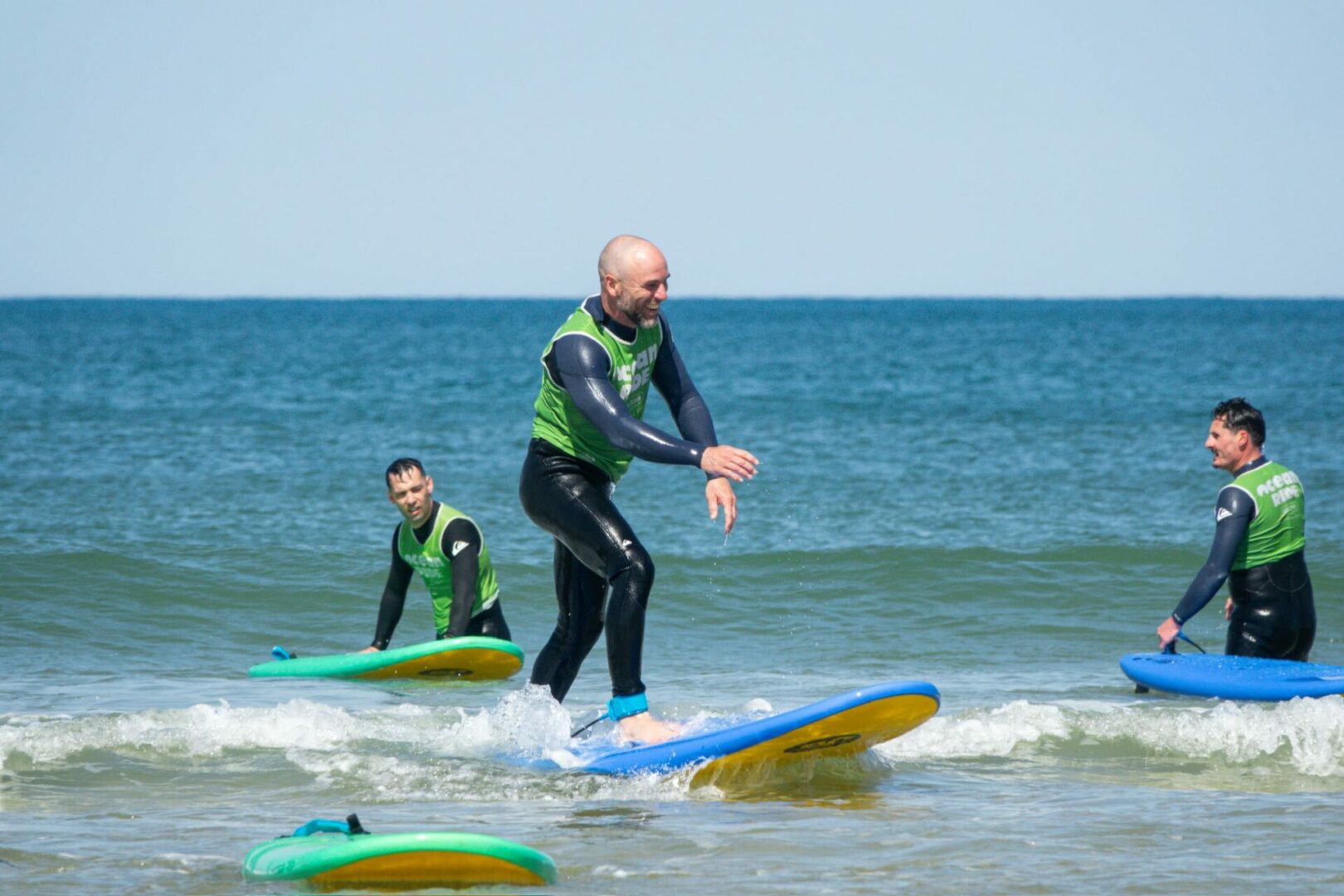
Can You Start Surfing at 30, 40 or 50?
Do you dream of surfing but wonder if you’re too old to start? Good news: you can start surfing at 30, 40, 50 and beyond. There is no maximum age for experiencing the thrill of riding your first waves.
However, learning to surf as an adult means adapting your practice to your level, your physical fitness and the ocean conditions. Choosing the right board, the size of the waves and having proper instruction also make a real difference.
At Ocean Ride Surf School in Lacanau-Océan, we help adult beginners progress through a straightforward learning process: understanding the ocean, learning safety rules, mastering your board, paddling, standing up and catching your first waves.
So, is starting to surf at 40 really more difficult? Here’s what you need to know before getting into the water.
Key Takeaways
- It’s not too late to start surfing at 30, 40 or 50: age matters less than your physical fitness, consistency and the conditions in which you learn.
- You don’t need to be particularly athletic: balance, paddling, the take-off and reading waves are skills you develop gradually.
- For an adult beginner, a stable, high-volume foam surfboard and small waves make learning considerably easier.
- Taking a few surf lessons for adults mainly helps you learn how to choose a suitable area, understand the dangers and build solid foundations before becoming independent.
Is It Too Late to Start Surfing at 30, 40 or 50?
No. There is no age limit for learning to surf. An adult aged 30, 40 or 50 can absolutely start surfing, provided the difficulty of the waves, the equipment and the intensity of the sessions are adapted to their abilities.
What changes with age is therefore not so much your ability to learn, but the way you approach learning.
At 30, you can generally rely on good physical abilities and recovery. At 40, warming up and progressing gradually become more important. At 50, you can also learn, but it becomes even more relevant to listen to your body and prioritise sessions suited to your abilities.
In fact, being an adult also brings a few advantages. You’re often more attentive to instructions, more patient and better able to analyse your mistakes.
And contrary to what surfing videos might suggest, your first objective isn’t to paddle out to the deeper water or perform manoeuvres.
It’s much simpler: catch a wave, stand up and begin to understand the ocean.
Is Learning to Surf at 40 More Difficult?
Learning to surf at 40 requires patience, but it isn’t necessarily too difficult. The main challenge comes from the fact that surfing combines several skills: paddling, balance, coordination, positioning, reading waves and standing up.
You therefore need to accept that you won’t master everything during your first session.
The First Skills You Need to Learn
When you’re starting out, you’ll gradually learn to:
- observe waves and currents;
- identify dangers;
- position your body correctly on the board;
- paddle efficiently;
- select a suitable wave;
- perform your take-off;
- find your balance while standing;
- begin to control your direction.
At Ocean Ride, beginners don’t head straight out to join experienced surfers offshore. Their first waves are caught in the whitewater, in an area selected according to the conditions and the group’s level.
It’s a much more accessible way to progress.

Do You Need to Be Fit to Start Surfing at 40 or 50?
No, you don’t need to be an athlete to start surfing as an adult. However, a minimum level of physical fitness that allows you to take part in water-based activities is still important.
Surfing particularly works your shoulders and arms while paddling, your legs when standing up and your core muscles to stabilise your body.
Balance, mobility, endurance and coordination then improve with practice.
How Can You Prepare Your Body Before Your First Lessons?
If you haven’t practised any sport for a long time, gradually returning to physical activity a few weeks before your first lesson can make the experience more comfortable.
Swimming, brisk walking, cycling or a little strength training provide a good foundation. Simple mobility exercises for your shoulders, hips and ankles can also be useful.
And above all: warm up before entering the water and give your body time to recover between sessions.
If you have a medical condition, an injury or any doubts about your ability to participate, seek advice from a healthcare professional beforehand.
Which Surfboard Should You Choose When Learning to Surf as an Adult?
To begin with, choose a stable, high-volume surfboard suited to your body size rather than a small, high-performance board.
It’s one of the classic mistakes: wanting to start with a shortboard because it looks like the boards used by experienced surfers.
A foam surfboard with enough volume provides greater buoyancy and stability. It makes paddling, catching waves and maintaining your balance easier.
As a result, you catch more waves and can practise your take-off more often.
And in surfing, catching more waves generally means having more opportunities to learn.
The right volume depends particularly on your weight, your level and your physical abilities. During Ocean Ride lessons, the board and wetsuit are provided, and the equipment is chosen according to each participant’s level.
To learn more, take a look at our guide “Hard Surfboard or Foam Surfboard: Which Should You Choose to Start or Improve Your Surfing?”.

How Many Surf Lessons Does an Adult Need to Learn to Surf?
There is no exact number of lessons required to “know how to surf”. Some people manage to stand up for the first time very quickly; becoming independent in the ocean, however, requires much more practice.
It’s an important distinction.
Being able to stand up for a few seconds on a whitewater wave doesn’t yet mean you know how to choose a surf spot, identify a current, select a wave or respect priorities in the line-up.
A Step-by-Step Learning Process
For an adult beginner, it’s more useful to think in terms of skills:
Step 1: Discover the ocean.
Understand waves, surfing areas and the main safety rules.
Step 2: Master your board.
Find the correct lying position and learn how to paddle.
Step 3: Perform a successful take-off.
Move smoothly from lying down to standing up.
Step 4: Catch waves regularly.
Improve your positioning, timing and balance.
Step 5: Gradually become more independent.
Learn to steer your board and, when your level and the conditions allow it, discover unbroken waves further offshore.
This progression explains why a surf course involving several sessions can be particularly beneficial: you repeat the movements and your instructor can correct your mistakes as you go.
How Can You Avoid Injuries When Starting Surfing After 40?
A few simple habits can help you surf in better conditions.
First of all, avoid overestimating your level. Rough seas or overly powerful waves can quickly turn a learning session into a battle against the ocean.
Next, warm up and gradually increase the duration and frequency of your sessions.
Finally, use suitable equipment and learn the right behaviours: knowing how to hold your board, fall correctly, protect your head when falling and maintain a safe distance from other surfers.
Don’t Underestimate the Importance of Reading the Ocean
Surfing isn’t just about knowing how to stand up.
Tides, swell, wind, sandbanks, currents and rip currents can all change the conditions at a surf spot.
That’s why learning with an instructor is particularly useful: you develop your technique while gradually acquiring what surfers often call ocean awareness.
Why Take Surf Lessons When Starting as an Adult?
Surf lessons allow adult beginners to learn technique, safety and an understanding of the ocean at the same time. It’s often the easiest way to avoid developing bad habits from your very first sessions.
At Ocean Ride in Lacanau, group surf lessons for adults are organised by age and ability, from beginners to more advanced surfers.
For beginners, the programme includes analysing conditions, identifying dangers, learning safety rules, mastering the board, selecting waves, paddling, standing up and maintaining balance.
Groups have a maximum of eight participants, and lessons are supervised by state-qualified instructors. Suitable surfboards and wetsuits are provided.
Choosing a lesson time doesn’t depend solely on your schedule: lessons are also organised according to the tide and the group’s level to find suitable learning conditions.
Discover our surf lessons and courses for adults in Lacanau to learn more about how they work.
Starting at 30, 40 or 50: What Really Changes?
The objective remains the same, but your approach may evolve with age.
| Age | Priority When Starting |
|---|---|
| 30 years old | Build solid foundations rather than trying to progress too quickly |
| 40 years old | Combine consistency, technique, warming up and recovery |
| 50 years old and over | Prioritise gradual progression and suitable conditions |
Of course, this table isn’t an absolute rule. A very active 52-year-old beginner may be more physically comfortable than a sedentary 30-year-old beginner.
Your actual age therefore doesn’t determine your ability to learn to surf on its own.
Your physical fitness, confidence in the water, frequency of practice, equipment, conditions and quality of instruction all play a role.
Why Learn to Surf in Lacanau with Ocean Ride?
Lacanau-Océan has a long-established surfing culture and offers different surf spots along its coastline. For a beginner, however, the challenge isn’t finding “the most beautiful wave”, but the area that matches your level on the day of your lesson.
Ocean Ride has been teaching surfing in Lacanau since 2010. The school is located on the seafront, and the instructors choose the surfing area according to the day’s conditions and the students’ levels.
Each session begins in particular with observing the ocean and reviewing the safety rules, before moving on to warming up and then exercises in the water. The instructor alternates between demonstrations, practice and individual advice.
So you learn not only how to surf, but also gradually how to understand the environment in which you’re surfing.
So, Is Starting to Surf at 40 Really a Good Idea?
Yes. Starting to surf at 40, 30 or 50 is entirely possible. The secret isn’t being young: it’s accepting that you’re a beginner.
Choose a suitable board, start in small waves, learn to read the ocean and give yourself time to repeat the movements.
And above all, don’t measure your first session by the number of seconds you spend standing up.
Understanding a wave, improving your paddling or successfully completing your first take-off are already signs of progress.
Since 2010, Ocean Ride has been helping surfers in Lacanau-Océan, from complete beginners to experienced surfers, with lessons organised according to age, level and conditions.
So if you’ve been watching the ocean for years, telling yourself “one day, I’ll give it a try”, your age probably isn’t the most important question.
The real question is: when will you catch your first wave?
FAQ – Starting Surfing as an Adult
Yes. It’s possible to start surfing at 50 without any previous experience. It’s recommended to choose small waves, a stable surfboard and suitable instruction to gradually learn paddling, the take-off, balance and safety rules.
You don’t need to be an experienced swimmer to try surfing in shallow water where you can stand, under the supervision of an instructor. However, knowing how to swim becomes essential when you move into deeper water and become more independent.
Yes, as long as you progress gradually. Starting in small whitewater waves allows you to become familiar with the ocean, the surfboard and the movement of the water before attempting bigger waves.
There is no single ideal time that works every day: conditions depend mainly on the swell, wind and tides. Ocean Ride therefore organises its lessons according to the students’ levels and the conditions to choose a suitable time for surfing.
